
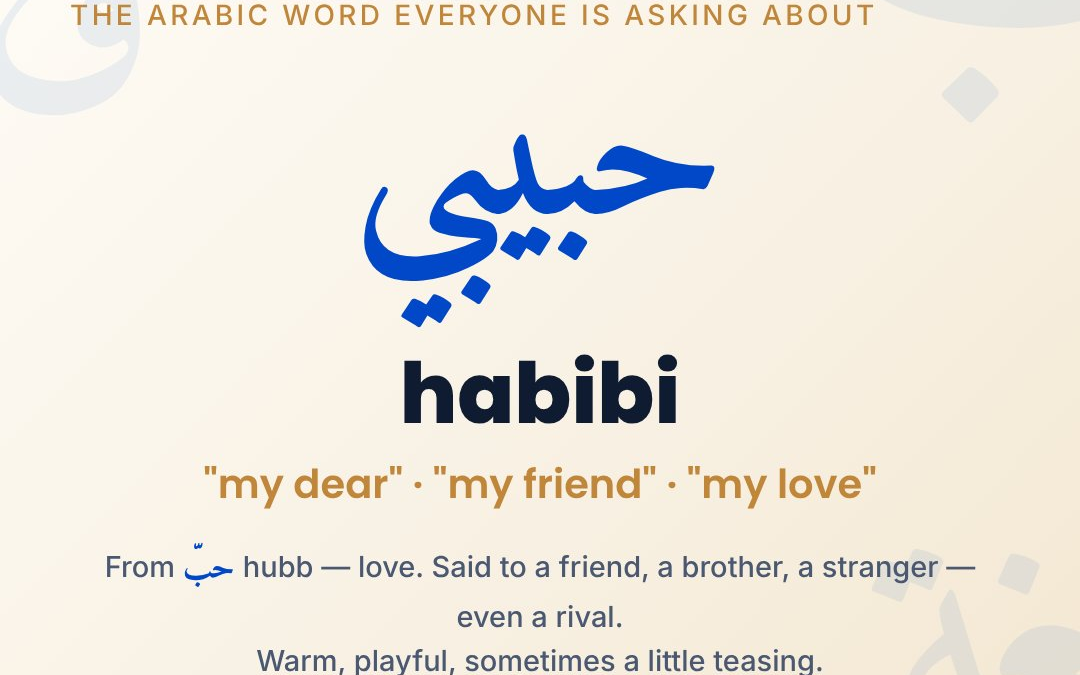
“J.D., habibi…” — three words from a victory speech in Michigan this week, and suddenly a whole country is asking the same question. Here is the short, honest answer, and a little more, because habibi is one of the most useful words you will ever learn in Arabic.
What “habibi” means, literally
حبيبي habibi comes from the root ح‑ب‑ب (h‑b‑b), the root of حبّ hubb — love. The word itself is حبيب habib, “beloved”, plus the ending ـي ‑i, “my”. So the dictionary meaning is simply “my beloved”.
Said to a woman, it becomes حبيبتي habibti.
What it means when people actually say it
If you only knew the dictionary meaning, you would think Arabs walk around declaring love to everyone. In a way, they do — but the word is far lighter in daily life than “my beloved” sounds in English. Depending on the tone, habibi can mean:
- “my dear” / “my friend” — to a brother, a cousin, a colleague, the shopkeeper, the taxi driver;
- “buddy” / “mate” — the warm, everyday version between men who are not related at all;
- “come on, man” — with a sigh, when someone is being difficult;
- “listen, my friend” — with a smile, when you are about to disagree, correct someone, or tease them;
- and, yes, still “my love” — to a partner or a child.
That last-but-one use is the one you heard in the speech. Addressing a rival as habibi is a very Arab move: it is polite on the surface, affectionate in form, and unmistakably pointed underneath. English has nothing quite like it; “my dear fellow” in a certain British accent comes closest.
Two more words from the same night
The same speech used two other Arabic expressions that are worth knowing, because you will hear them from every Arabic speaker you ever meet:
- إن شاء الله inshallah — “God willing”. Said about anything in the future: See you tomorrow, inshallah. We have a whole post on inshallah — it is more subtle than it looks.
- الحمد لله alhamdulillah — “praise be to God”. Said when something has worked out, or simply as the answer to “how are you?”.
The speaker’s joke was that the campaign’s inshallah (hope for the future) had become alhamdulillah (gratitude for what happened). If you understood that line, you understood two of the most important words in the language.
How to use “habibi” without sounding odd
- Men to men, women to women, family to family: safe, warm, universal.
- To a stranger of the opposite sex: be careful — it can read as flirting unless the context is clearly friendly (a waiter, a grandmother). When in doubt, use a name.
- Pronunciation: ha‑BEE‑bee. The first “h” is the soft, breathy ح — the sound you make fogging up a mirror — not the English “h”.
- Spelling in English: you will see habibi, 7abibi (the 7 stands for ح in Arabic chat), and habibti for women. All the same word.
Read it yourself
Here is the word again, and this time try to read it: حَبِيبِي. Right to left: ح ha · ب bi · ي (long ee) · ب b · ي ee. Five letters, three of which you meet in the very first lesson of the alphabet.
If you want to be reading Arabic words like this one in a week, our Arabic Alphabet & Essential Vowels course is free, in English, French and German, with an Arabic keyboard on screen so you never need to install one.
Habibi, you can do this.