
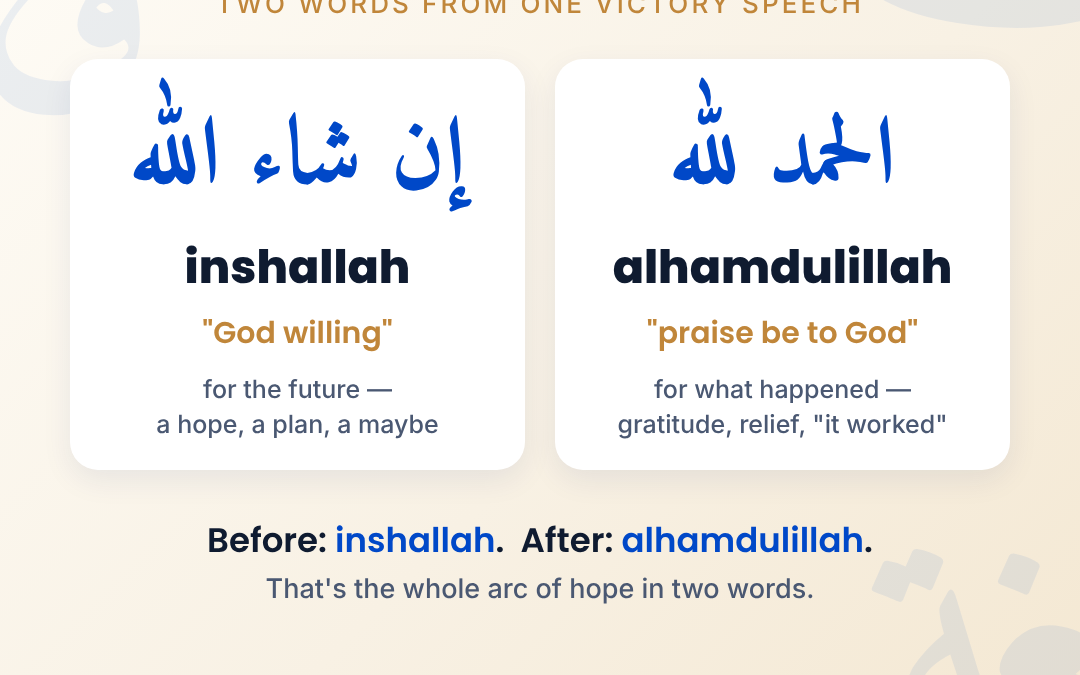
When Michigan’s senator-elect stood up to give his victory speech this week, he told the crowd that he always says inshallah — and that tonight they could turn that inshallah into alhamdulillah. The room understood instantly. Half the internet went looking for a translation.
Here it is — and more importantly, here is why that one line landed so well. Because these two words are not just vocabulary. Together they describe a whole way of thinking about the future and the past.
Inshallah — the word for everything that hasn’t happened yet
إن شاء الله inshallah is three words: إن in (if), شاء sha’a (he wills), الله Allah (God). Literally: “if God wills”. In practice: “God willing” — and it goes on the end of almost any sentence about the future.
- See you tomorrow, inshallah.
- The package arrives Monday, inshallah.
- We’ll win, inshallah.
Arabic speakers of every religion say it, and so do many non-Arabs across the Muslim world. It carries humility — nobody controls tomorrow — but it is also simply polite. Announcing a future plan without it can sound almost arrogant.
And yes, there is a second, famous meaning. Said with a shrug and a certain tone, inshallah is the gentlest way in the world to say “probably not”. Every Arab child learns this the first time they ask for ice cream. We wrote a whole post on that side of the word: What inshallah really means.
Alhamdulillah — the word for everything that already has
الحمد لله alhamdulillah: الحمد al-hamd (the praise) + لله lillah (to God). “Praise be to God” — the word of gratitude, relief and acceptance.
You will hear it far more often than you expect, because it is not reserved for big moments:
- as the answer to How are you? — Alhamdulillah (fine, thank God);
- after a meal, after a sneeze, after landing safely, after an exam;
- when something went well — and, remarkably, when something went badly too. Alhamdulillah ‘ala kulli hal, “praise God in every situation”, is what people say after bad news.
Spellings vary — alhamdulillah, al-hamdu lillah, hamdullah — all the same phrase.
Why “turn inshallah into alhamdulillah” was such a good line
Put the two words side by side and you have the whole arc of hope:
Before: inshallah — the plan, the wish, the uncertainty.
After: alhamdulillah — it happened, thank God.
Arabic speakers live between these two words every day. Every goal starts as an inshallah; every one that comes true becomes an alhamdulillah. So when a speaker says “let’s turn our inshallah into alhamdulillah”, every Arabic speaker in the room hears months of hoping resolved into one night of gratitude — in five words. No translation does that justice, which is exactly why it was worth learning the original.
How to use them yourself
- Inshallah goes after a future plan: I’ll call you tonight, inshallah. Pronounce it in-SHA-lah, three syllables, the stress in the middle.
- Alhamdulillah goes after good news, or as a reply to “how are you?”: al-HAM-du-lil-LAH.
- Both are fine for non-Muslims and non-Arabs to use — they are everyday language, and people will smile when they hear you say them correctly.
- Don’t use inshallah as a joke for “never” with people you don’t know well; the “probably not” meaning is real, but it belongs to friends.
Read them in Arabic
إن شاء الله — إ alif with hamza below (i) · ن nun · ش shin · ا alif · ء hamza · الله Allah.
الحمد لله — ال al · ح ha · م mim · د dal · لله lillah.
Between them these two phrases use ten different letters — more than a third of the alphabet. If you can read these, you are most of the way to reading anything. Our Arabic Alphabet & Essential Vowels course is free, in English, French and German, with an Arabic keyboard on screen so you never need to install one.
You’ll be reading Arabic in a week — inshallah. And then: alhamdulillah.