
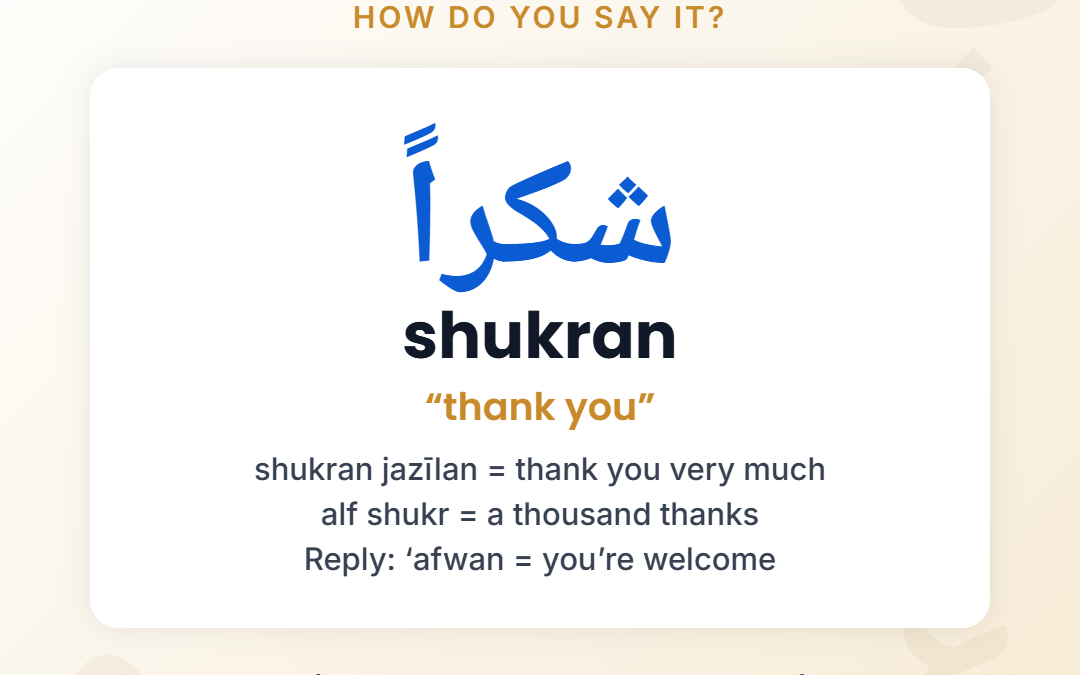
Thank you in Arabic is shukran شكراً, pronounced SHOOK-ran. It works everywhere, with everyone. To say “thank you very much,” say shukran jazīlan شكراً جزيلاً. And when someone thanks you, the usual reply is ‘afwan عفواً, “you’re welcome.”
That covers 90% of situations. But Arabic has many warmer, more personal ways to thank someone, and using one of them is a quick way to make an Arabic speaker smile.
The main ways to say thank you
| Arabic | Say it | Meaning / when to use it |
|---|---|---|
| شكراً | shukran | thank you — everywhere, any situation |
| شكراً جزيلاً | shukran jazīlan | thank you very much — polite, a little formal |
| ألف شكر | alf shukr | a thousand thanks — warm, friendly |
| مشكور | mashkūr (mashkūra to a woman) | “you are thanked” — very common in the Levant and Gulf |
| يسلمو | yislamū | literally “may (your hands) be safe” — Levant, friendly |
| تسلم | tislam (tislamī to a woman) | “may you be safe” — Egypt and the Levant |
| جزاك الله خيراً | jazāk Allāhu khayran | “may God reward you with good” — religious, heartfelt |
| ميرسي | mersī | from French “merci” — Lebanon, Syria, North Africa |
How to reply to “thank you”
| Arabic | Say it | Meaning |
|---|---|---|
| عفواً | ‘afwan | you’re welcome |
| العفو | al-‘afw | you’re welcome (also very common) |
| لا شكر على واجب | lā shukr ‘alā wājib | no thanks needed for a duty — polite and warm |
| تكرم | tikram (tikramī to a woman) | it’s my pleasure / for you, anything — Levant |
| وإياك | wa iyyāk | and you too — the reply to jazāk Allāhu khayran |
Which one should you use?
- In a shop, café or taxi: shukran. Simple and perfect.
- When someone goes out of their way for you: shukran jazīlan or alf shukr.
- With Lebanese, Syrian, Palestinian or Jordanian friends: yislamū or mashkūr sound natural and warm.
- In Egypt: shukran and tislam are everywhere; mutashakkir متشكر is the Egyptian “I am thankful.”
- With religious friends, or after a real favour: jazāk Allāhu khayran.
Pronunciation help
Shukran has a short, clear “oo” and a rolled r: SHOOK-ran, not shoe-KRAN. In jazīlan the stress is on the long “ee”: ja-ZEE-lan. In ‘afwan the first sound is the throaty ع ‘ayn; if you can’t make it yet, just start with “af” — you will still be understood.
A short real-life dialogue
Guest: شكراً جزيلاً على العشاء! Shukran jazīlan ‘alā al-‘ashā’! — Thank you very much for dinner!
Host: العفو! صحتين. Al-‘afw! Ṣaḥtayn. — You’re welcome! Enjoy (literally “double health”).
Guest: تسلم إيدك. Tislam īdak. — Bless your hands (said to the cook).
That last one, tislam īdak / īdik, “may your hand be safe,” is the perfect thing to say after a home-cooked meal anywhere in the Arab world.
Read it yourself
شُكْراً — ش sh · ك k (with the little circle, sukun: no vowel) · ر r · اً -an. Four letters, and you can read your first Arabic word.
Want to read and write words like shukran yourself? Our Arabic Alphabet & Essential Vowels course is free, in English, French and German, with an Arabic keyboard on screen so you never need to install one.
FAQ
What is thank you in Arabic?
Shukran (شكراً). “Thank you very much” is shukran jazīlan (شكراً جزيلاً).
How do you respond to shukran?
Say ‘afwan (عفواً) or al-‘afw (العفو), both meaning “you’re welcome.”
What does jazak Allah khayran mean?
“May God reward you with good.” It is a heartfelt, religious way to say thank you. The reply is wa iyyāk.
Is shukran the same in all Arab countries?
Yes, shukran is understood everywhere. Each region also has its own warm alternatives, like yislamū in the Levant.
How do you say thank you to a woman in Arabic?
Shukran is the same for everyone. Forms like mashkūra, tislamī and jazāki Allāhu khayran are the versions addressed to a woman.