
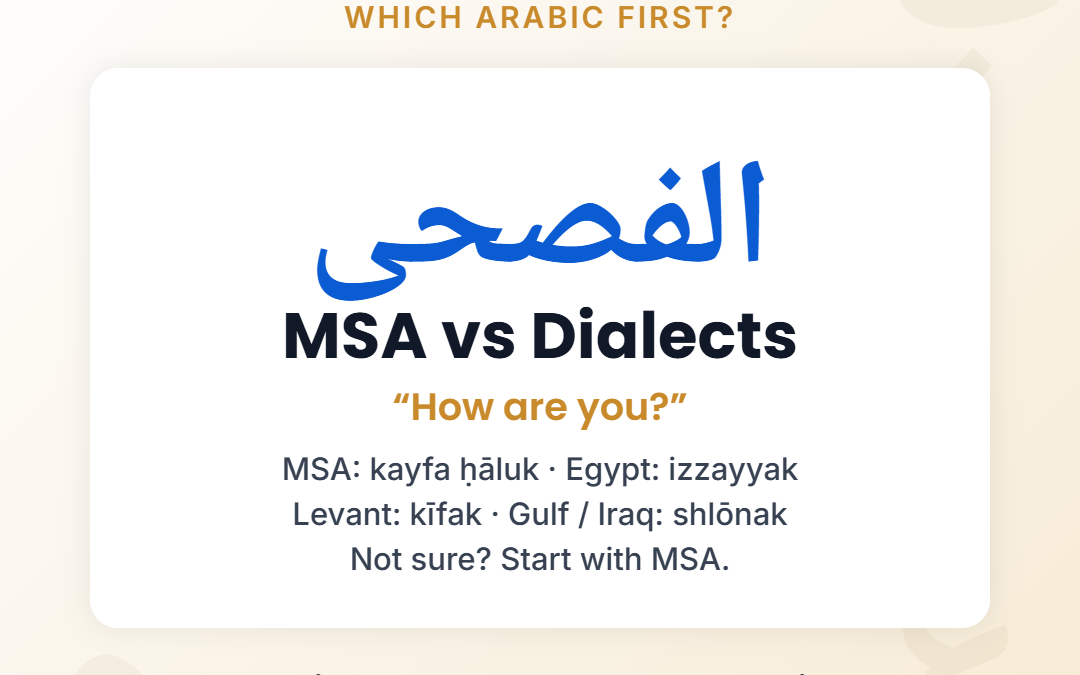
Modern Standard Arabic (MSA), الفصحى al-fuṣḥā, is the shared formal Arabic used in books, news, official documents and speeches across all 22 Arab countries. The dialects — Egyptian, Levantine, Gulf, Iraqi, Maghrebi and others — are what people speak at home and in the street. If you are not sure which to learn, start with MSA and the alphabet, then add one dialect for speaking.
One language, two layers
Linguists call this situation diglossia: a formal written variety and everyday spoken varieties living side by side. An Egyptian and a Moroccan read the same newspaper in MSA, but at home they speak dialects that can sound quite different. Every educated Arabic speaker understands MSA, and almost every dialect word is related to an MSA word.
How different are they? A few examples
| English | MSA | Egyptian | Levantine | Gulf / Iraqi |
|---|---|---|---|---|
| How are you? | kayfa ḥāluk? كيف حالك؟ | izzayyak? إزيك؟ | kīfak? كيفك؟ | shlōnak? شلونك؟ |
| What? | mādhā? ماذا؟ | eh? إيه؟ | shū? شو؟ | shinū? شنو؟ |
| I want | urīd أريد | ‘āyiz عايز | baddī بدي | abī / arīd أبي |
| Now | al-ān الآن | dilwa’ti دلوقتي | halla’ هلق | ḥaṣṣa / hassa هسة |
| Good / fine | jayyid جيد | kuwayyis كويس | mnīḥ منيح | zēn زين |
The grammar core and most vocabulary are shared; the everyday words, pronunciation and some verb forms change.
Which one should you learn first?
| Your goal | Start with |
|---|---|
| Read books, news, signs; study; work in media or government | MSA |
| Read the Quran | The alphabet + Classical/Quranic Arabic (very close to MSA) |
| Talk with a partner, family or friends from one country | Alphabet + MSA basics, then that country’s dialect early |
| Understand films, TV and songs | MSA basics, then Egyptian or Levantine (most widely heard in media) |
| Travel to many Arab countries | MSA basics + a few greetings in the local dialect |
| Not sure yet | MSA — it opens every door later |
Why we start with the alphabet and MSA
- Everything written is in MSA. Menus, signs, messages and subtitles all use it.
- Dialects are easier after MSA. Once you know the roots and patterns, dialect words become recognisable variants rather than new words.
- You are understood everywhere. People may smile at “textbook” Arabic, but they understand it and appreciate the effort.
When to add a dialect
As soon as you can read comfortably and know a few hundred words — often after two or three months — pick one dialect and stick with it. Learning two at once is the fastest way to mix them up.
Which dialect is easiest?
There is no single answer, but Egyptian is the most widely understood thanks to decades of Egyptian films and TV, and Levantine (Lebanon, Syria, Jordan, Palestine) is popular with learners for its clear pronunciation and huge amount of online content. Gulf and Iraqi Arabic stay closer to MSA in many words. Maghrebi Arabic (Morocco, Algeria, Tunisia) is the most different for beginners.
Whichever Arabic you choose, it starts with the same 28 letters. Our Arabic Alphabet & Essential Vowels course is free, in English, French and German, with an Arabic keyboard on screen so you never need to install one.
FAQ
What is Modern Standard Arabic?
The formal, shared Arabic used in writing, news and official speech across the Arab world. In Arabic it is called al-fuṣḥā.
Do Arabs speak MSA in daily life?
Not usually. Daily conversation is in local dialects, but everyone understands MSA.
Should I learn MSA or Egyptian Arabic first?
Start with the alphabet and MSA basics unless you only need to talk with Egyptians; then begin with Egyptian early.
Is Quranic Arabic the same as MSA?
They are very close. Quranic (Classical) Arabic has some older vocabulary and style, but the script, grammar and most words are shared.
Which Arabic dialect is the most useful?
Egyptian is the most widely understood. The most useful dialect is the one spoken by the people you want to talk to.