
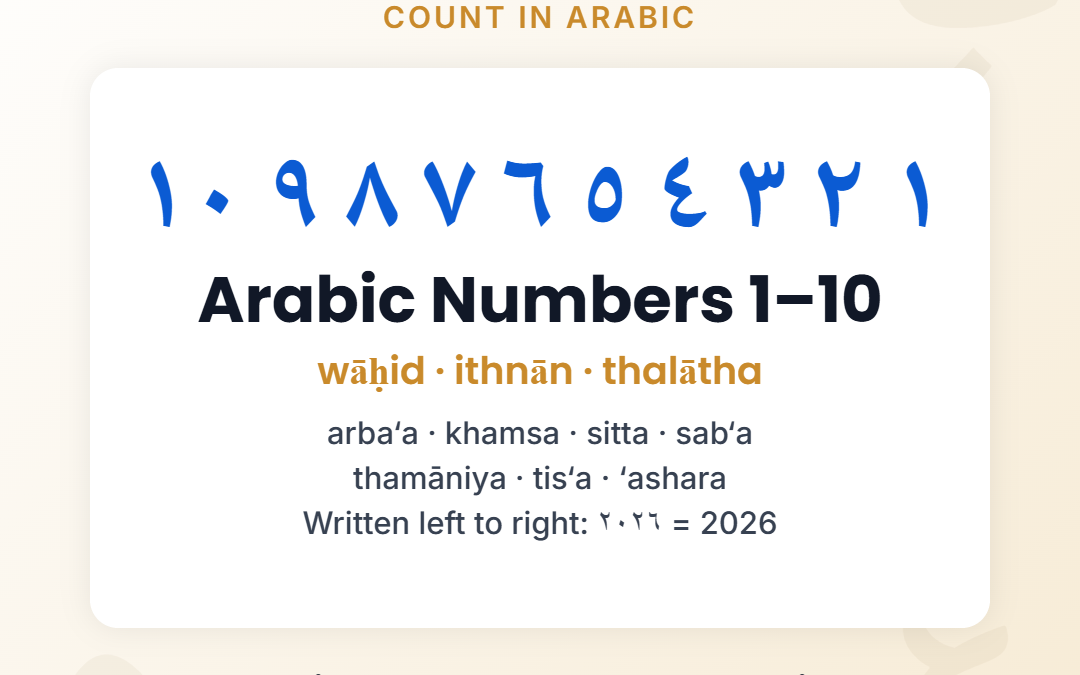
Here are the Arabic numbers 1 to 10: wāḥid, ithnān, thalātha, arba‘a, khamsa, sitta, sab‘a, thamāniya, tis‘a, ‘ashara. In much of the Arab world they are written with these digits: ١ ٢ ٣ ٤ ٥ ٦ ٧ ٨ ٩ ١٠. Below you’ll find each one with its pronunciation, then 11 to 20, the tens and 100.
Numbers 0–10
| Number | Digit | Arabic word | Say it |
|---|---|---|---|
| 0 | ٠ | صفر | ṣifr |
| 1 | ١ | واحد | wāḥid |
| 2 | ٢ | اثنان | ithnān |
| 3 | ٣ | ثلاثة | thalātha |
| 4 | ٤ | أربعة | arba‘a |
| 5 | ٥ | خمسة | khamsa |
| 6 | ٦ | ستة | sitta |
| 7 | ٧ | سبعة | sab‘a |
| 8 | ٨ | ثمانية | thamāniya |
| 9 | ٩ | تسعة | tis‘a |
| 10 | ١٠ | عشرة | ‘ashara |
Wait — aren’t 1, 2, 3 already “Arabic numerals”?
Yes, and that confuses everyone. The digits used in English (0–9) came to Europe through Arab mathematicians, so they are called “Arabic numerals.” In the Middle East, though, most countries use a different set of digits, ٠١٢٣٤٥٦٧٨٩, often called Eastern Arabic or Hindi numerals. North Africa (Morocco, Algeria, Tunisia) mostly uses 0–9. You will see both, so it is worth learning to recognise the Eastern ones.
One surprise: although Arabic text is written right to left, numbers are written left to right. 2026 is ٢٠٢٦, with the 2 first.
Tips to tell the digits apart
- ٠ zero is a small dot, and ٥ five looks like a small circle — don’t mix them up.
- ٧ seven is a V shape, and ٨ eight is the same shape upside down.
- ٤ four looks a bit like a backwards 3, and ٦ six like a small 7 with a curl.
11 to 100
| Number | Digits | Arabic word | Say it |
|---|---|---|---|
| 11 | ١١ | أحد عشر | aḥada ‘ashar |
| 12 | ١٢ | اثنا عشر | ithnā ‘ashar |
| 13 | ١٣ | ثلاثة عشر | thalāthata ‘ashar |
| 14 | ١٤ | أربعة عشر | arba‘ata ‘ashar |
| 15 | ١٥ | خمسة عشر | khamsata ‘ashar |
| 20 | ٢٠ | عشرون | ‘ishrūn |
| 21 | ٢١ | واحد وعشرون | wāḥid wa-‘ishrūn |
| 30 | ٣٠ | ثلاثون | thalāthūn |
| 40 | ٤٠ | أربعون | arba‘ūn |
| 50 | ٥٠ | خمسون | khamsūn |
| 60 | ٦٠ | ستون | sittūn |
| 70 | ٧٠ | سبعون | sab‘ūn |
| 80 | ٨٠ | ثمانون | thamānūn |
| 90 | ٩٠ | تسعون | tis‘ūn |
| 100 | ١٠٠ | مئة | mi’a |
Notice the pattern: the tens end in -ūn (‘ishrūn, thalāthūn…), and they are built from the small numbers (thalātha → thalāthūn). For 21–99 you say the units first: 21 is wāḥid wa-‘ishrūn, literally “one and twenty” — like the old English “four-and-twenty blackbirds.”
The rule that surprises every beginner
With nouns, the numbers 3 to 10 take the opposite gender of the thing you are counting: you say thalāthat kutub ثلاثة كتب (three books) but thalāth banāt ثلاث بنات (three girls). Don’t worry about it on day one — when you simply count, use the forms in the table above, and everyone will understand you.
Numbers in everyday speech
In dialects the numbers are mostly the same with small sound changes: Egyptians say talāta for 3 and tamanya for 8, and in the Levant you will hear tlēte and tmēnye. “Two” is often itnēn.
Practise
- Count out loud from 1 to 10 every day this week.
- Read the price tags and phone numbers you see in Arabic videos and photos.
- Write today’s date in Arabic digits, for example ١٨ / ١١ / ٢٠٢٦.
Learning to read the number words is the same as reading any other word. Our Arabic Alphabet & Essential Vowels course is free, in English, French and German, with an Arabic keyboard on screen so you never need to install one.
FAQ
What are the Arabic numbers 1 to 10?
wāḥid (1), ithnān (2), thalātha (3), arba‘a (4), khamsa (5), sitta (6), sab‘a (7), thamāniya (8), tis‘a (9), ‘ashara (10).
How are Arabic numbers written?
Most Middle Eastern countries use the digits ٠١٢٣٤٥٦٧٨٩; North Africa mostly uses 0–9. Numbers are written left to right.
How do you say zero in Arabic?
Ṣifr (صفر). The English word “cipher” and the word “zero” both come from it.
How do you count to 100 in Arabic?
Learn 1–10, then the tens ending in -ūn (‘ishrūn, thalāthūn…). Numbers like 25 are said “five and twenty”: khamsa wa-‘ishrūn. 100 is mi’a.
Why are 3 to 10 different with masculine and feminine nouns?
Arabic numbers 3–10 take the opposite gender of the counted noun. It is a grammar rule you can learn later; for counting, the basic forms are enough.