
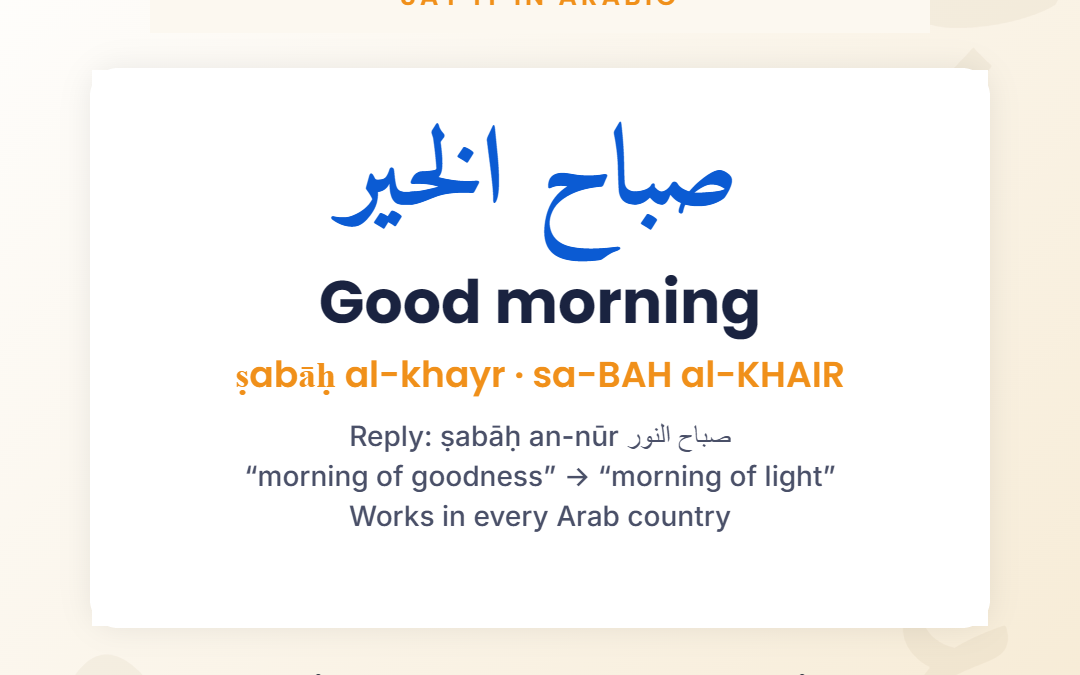
Good morning in Arabic is ṣabāḥ al-khayr صباح الخير, pronounced sa-BAH al-KHAIR. It literally means “morning of goodness.” The reply is ṣabāḥ an-nūr صباح النور, “morning of light.” That exchange works in every Arab country, with everyone, formal or casual.
Arabic speakers rarely stop there, though. Mornings come with a small ritual of greetings, and knowing two or three of them makes you sound far more natural than a textbook learner.
The main ways to say good morning
| Arabic | Say it | Meaning / when to use it |
|---|---|---|
| صباح الخير | ṣabāḥ al-khayr | good morning — the standard everywhere |
| صباح النور | ṣabāḥ an-nūr | “morning of light” — the reply |
| صباح الورد | ṣabāḥ al-ward | “morning of roses” — warm, Levant & Egypt |
| صباح الفل | ṣabāḥ al-full | “morning of jasmine” — Egyptian, very friendly |
| صبّحك الله بالخير | ṣabbaḥak Allāh bil-khayr | “may God give you a good morning” — Gulf, Iraq |
| صباحو | ṣabāḥo | “mornin’!” — casual Levantine shorthand |
| مساء الخير | masāʾ al-khayr | good evening (reply: masāʾ an-nūr) |
How to reply to ṣabāḥ al-khayr
The classic answer is ṣabāḥ an-nūr. But Arabs love to escalate: if someone gives you “morning of goodness,” you give back “morning of light,” they come back with “morning of roses,” and you win the exchange with “morning of jasmine.” Nobody actually keeps score — it is just a playful way of being generous with words. Any of the greetings in the table is an acceptable reply to any other.
Saying it to a man, a woman, or a group
Ṣabāḥ al-khayr itself never changes — it has no “you” in it. The longer form does: ṣabbaḥak Allāh bil-khayr to a man, ṣabbaḥik to a woman, ṣabbaḥkum to a group. The same three endings (-ak, -ik, -kum) show up in almost every Arabic phrase, so they are worth learning once.
Good morning in the dialects
- Egypt: ṣabāḥ el-kheir, answered with ṣabāḥ el-full or ṣabāḥ el-ʾishṭa (“morning of cream” — yes, really).
- Levant (Syria, Lebanon, Jordan, Palestine): ṣabāḥ el-kheir / ṣabāḥo, answered with ṣabāḥ el-ward.
- Gulf & Iraq: ṣabāḥ el-kheir or the fuller ṣabbaḥak Allāh bil-khayr.
- Morocco: ṣbāḥ l-khīr — same words, squeezed vowels.
A short real-life dialogue
Layla: صباح الخير يا عمر — Ṣabāḥ al-khayr ya Omar. — Good morning, Omar.
Omar: صباح النور! كيفك اليوم؟ — Ṣabāḥ an-nūr! Kīfik el-yōm? — Morning of light! How are you today?
Layla: الحمد لله، تمام. قهوة؟ — Alhamdulillah, tamām. Qahwa? — Thank God, all good. Coffee?
Omar: أكيد! — Akīd! — Of course!
Read it yourself
صَبَاح — ص ṣ (a heavy “s”) · ب b · ا ā · ح ḥ. Then الخَيْر — al- ال “the” · خ kh (like Scottish “loch”) · ي y · ر r. Two words, and you can read a greeting you will hear every single day.
Want to read and write words like this yourself? Our Arabic Alphabet & Essential Vowels course is free, in English, French and German, with an Arabic keyboard on screen so you never need to install one.
Related: Thank you in Arabic · 50 basic Arabic words and phrases
FAQ
How do you say good morning in Arabic?
Ṣabāḥ al-khayr (صباح الخير). It is understood in every Arabic-speaking country.
What is the reply to ṣabāḥ al-khayr?
Ṣabāḥ an-nūr (صباح النور), “morning of light.” Warmer replies are ṣabāḥ al-ward (roses) and ṣabāḥ al-full (jasmine).
What does ṣabāḥ al-khayr literally mean?
“Morning of goodness” — ṣabāḥ is morning, al-khayr is the good.
Until what time can I say ṣabāḥ al-khayr?
Roughly until noon or early afternoon. After that switch to masāʾ al-khayr, good evening.
Is there a casual way to say good morning in Arabic?
Yes — ṣabāḥo in the Levant, or simply ṣabāḥ with a smile. Between friends, ṣabāḥ al-full is the friendliest of all.