
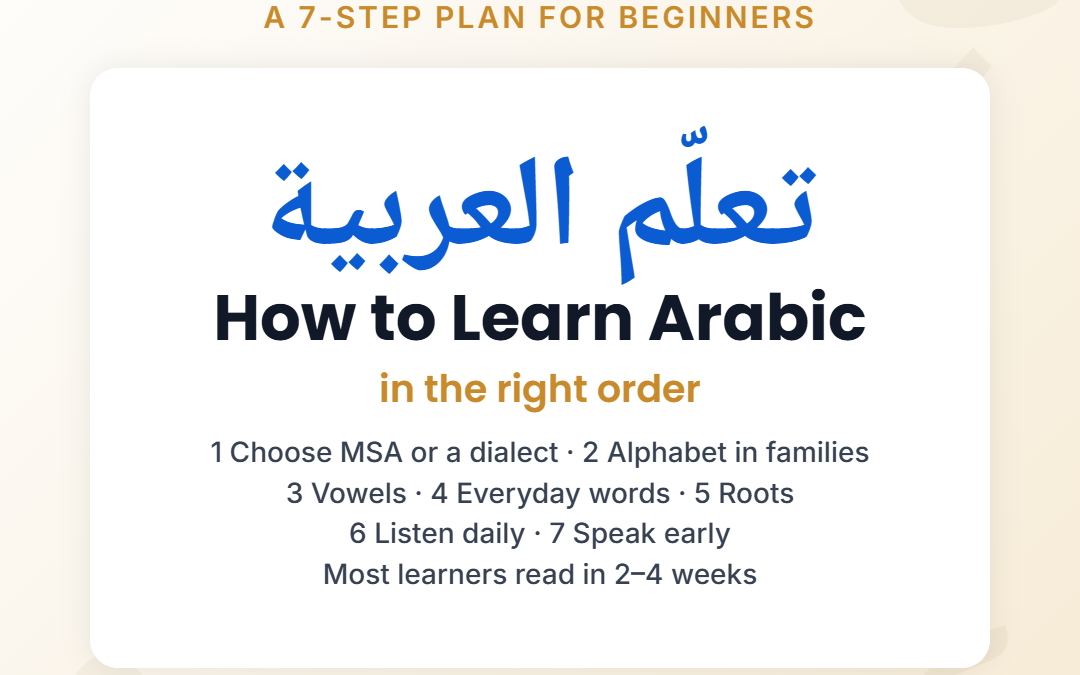
The best way to learn Arabic is to take it in the right order: decide which Arabic you need, learn the alphabet properly, add the vowels, then build vocabulary through roots, and listen and speak every day. Most people who give up do so because they start in the middle — with phrasebooks or apps that skip the script — and hit a wall a few weeks later.
Here is the step-by-step plan we use with beginners at Arabicy.
Step 1: Decide which Arabic you need
Arabic has a formal, shared written form — Modern Standard Arabic (MSA), الفصحى al-fuṣḥā — and many spoken dialects (Egyptian, Levantine, Gulf, Iraqi, Maghrebi). Your goal decides the starting point:
- Reading, news, study, or the Quran: start with MSA (and Classical Arabic for the Quran).
- Talking with family, friends or colleagues from one country: learn the alphabet and MSA basics, then switch early to that dialect.
- Not sure yet: start with MSA. It is understood everywhere and every dialect builds on it.
Step 2: Learn the alphabet — properly, in families
Arabic has 28 letters, written right to left, and most of them connect to their neighbours. That sounds like a lot until you notice that many letters share the same basic shape and differ only by dots: ب ت ث (b, t, th) are one shape with one, two or three dots.
So instead of memorising 28 separate letters, learn them in families by shape. That is exactly how our method works — we explain it in The Arabic alphabet, reorganized. Most learners can recognise every letter within one to two weeks this way.
Step 3: Add the vowels
Arabic has only three vowel sounds — a, i, u — each short or long. The long vowels are letters (ا و ي); the short ones are small marks above or below the letters (fatha, kasra, damma). Learn them together with the alphabet, not after it, and you can read real words from week one. Our guide Arabic vowels explained covers all of them, including sukun and shadda.
Step 4: Learn the words people actually use
Start with greetings, polite phrases, numbers, family, food and time. A few hundred everyday words take you a long way. Fifty well-chosen words and phrases are a good first target.
Step 5: Use the root system
Most Arabic words grow from a three-letter root. ك-ت-ب (k-t-b) gives كتب kataba (he wrote), كتاب kitāb (book), مكتب maktab (office, desk) and مكتبة maktaba (library). Once you see the pattern, one root unlocks a whole family of words. See the Arabic root system explained.
Step 6: Listen every day
Ten to fifteen minutes of listening a day — slow podcasts, children’s songs, short videos with subtitles — trains your ear for sounds English doesn’t have, like ع ‘ayn and ح ḥā’. Repeat out loud what you hear.
Step 7: Speak early, with short dialogues
Don’t wait until you “know enough.” Practise short, real dialogues — greeting, ordering, introducing yourself — from the first month. Every Arabicy lesson ends with a dialogue for exactly this reason.
A realistic weekly routine
| Day | 20–30 minutes |
|---|---|
| Sun–Thu | One new lesson (letters or a grammar point) + review yesterday |
| Every day | 10 minutes listening, 5 minutes reading aloud |
| Friday | Review the week, practise one dialogue out loud |
| Saturday | Rest or something fun: a song, a film clip, Arabic calligraphy |
How long will it take?
Reading and writing the script: a few weeks. Basic conversation: a few months of steady practice. Real fluency takes longer — the U.S. Foreign Service Institute puts Arabic in its hardest category for English speakers, at roughly 2,200 class hours. More detail in How long does it take to learn Arabic?
Common mistakes to avoid
- Learning only through transliteration (Latin letters). It feels faster, then blocks you.
- Switching between three dialects at once.
- Studying grammar tables without hearing or saying anything.
- Long, irregular sessions instead of short daily ones.
The best first step is the alphabet. Our Arabic Alphabet & Essential Vowels course is free, in English, French and German, with an Arabic keyboard on screen so you never need to install one.
FAQ
What is the easiest way to learn Arabic?
Learn the alphabet in shape families together with the vowels, then build vocabulary through roots and practise short dialogues every day.
Should I learn MSA or a dialect first?
If you are unsure, start with MSA. Choose a dialect early if you mainly want to talk with people from one country.
Can I learn Arabic by myself?
Yes, with a structured course for the script and grammar, daily listening, and some speaking practice with a partner or tutor.
How many letters does Arabic have?
28 letters, written from right to left. Many share the same shape and differ only in their dots.
How long does it take to read Arabic?
Most beginners can read simple words with vowel marks within two to four weeks of daily practice.