
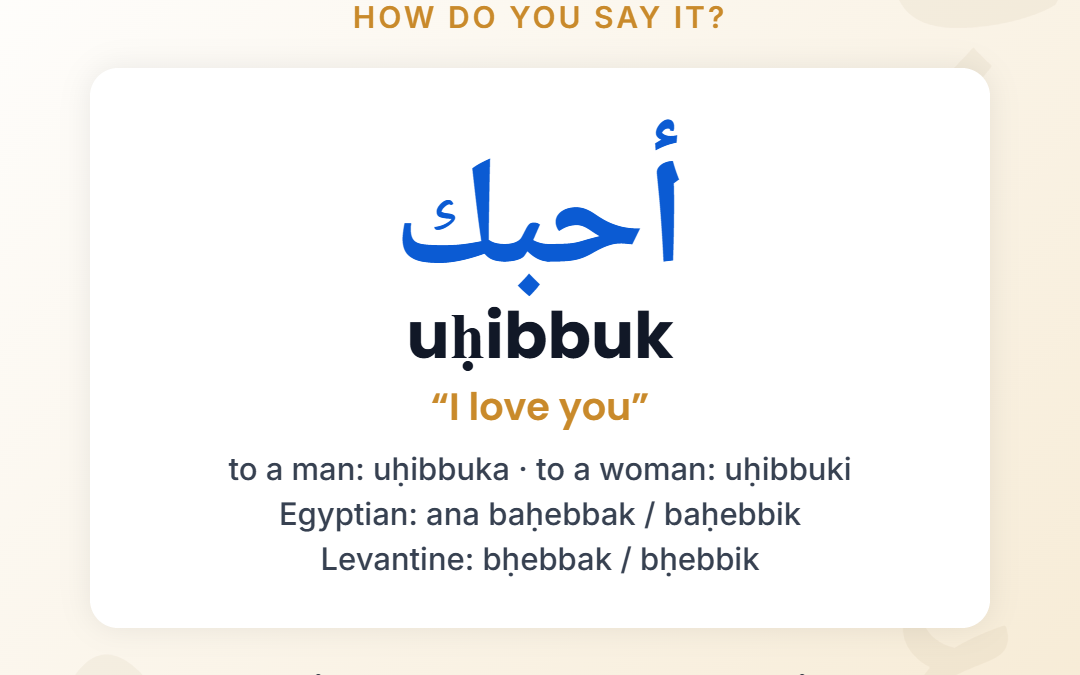
“I love you” in Arabic is uḥibbuk أحبك. In careful Arabic it changes with the person you say it to: uḥibbuka to a man and uḥibbuki to a woman. In everyday speech you will more often hear the dialect forms, like Egyptian baḥebbak / baḥebbik.
“I love you” to a man or to a woman
| Said to | Arabic | Say it |
|---|---|---|
| a man | أُحِبُّكَ | uḥibbuka |
| a woman | أُحِبُّكِ | uḥibbuki |
| several people | أُحِبُّكُم | uḥibbukum |
The root is ح-ب-ب (ḥ-b-b), love — the same root as habibi. The ending tells you who is loved: -ka “you (man)”, -ki “you (woman)”.
How people actually say it, by region
| Region | To a man | To a woman |
|---|---|---|
| Egypt | ana baḥebbak أنا بحبك | ana baḥebbik أنا بحبك |
| Lebanon, Syria, Palestine, Jordan | bḥebbak بحبك | bḥebbik بحبك |
| Gulf | aḥibbak أحبك | aḥibbich أحبچ |
| Iraq | aḥibbak أحبك | aḥibbich أحبچ |
| Morocco | kanbghik كنبغيك | kanbghik كنبغيك |
Notice that Egyptian and Levantine Arabic write the man and woman forms the same way — the difference is only in the vowel you hear at the end.
Sweet words that go with it
- حبيبي / حبيبتي ḥabībī / ḥabībtī — my love, my dear (to a man / to a woman).
- يا روحي yā rūḥī — my soul.
- يا قلبي yā qalbī (yā albī in Egypt and the Levant) — my heart.
- يا عمري yā ‘umrī — my life.
- حياتي ḥayātī — my life.
- اشتقت لك ishtaqtu lak — I missed you (to a man; laki to a woman).
These are not only for couples. Parents say yā rūḥī and yā ‘umrī to their children all the time, and friends call each other ḥabībī constantly.
How to answer “I love you”
- وأنا كمان w-ana kamān — me too (Egypt, Levant).
- وأنا أحبك أيضاً wa anā uḥibbuka/uḥibbuki ayḍan — and I love you too (standard Arabic).
- وأنا أكثر w-ana aktar — and I (love you) more.
A little dialogue
Nour: بحبك يا قلبي. Bḥebbak yā albī. — I love you, my heart.
Adam: وأنا بحبك أكتر. W-ana bḥebbik aktar. — And I love you more.
Read it yourself
أُحِبُّكِ: أ the hamza with “u” · ح ḥi (breathy h) · بّ b with a shadda, so you double it: bb · ك k with kasra: ki. Uḥibbuki.
Writing “I love you” in Arabic for someone special starts with four letters. Our Arabic Alphabet & Essential Vowels course is free, in English, French and German, with an Arabic keyboard on screen so you never need to install one.
FAQ
How do you say I love you in Arabic?
Uḥibbuk (أحبك): uḥibbuka to a man, uḥibbuki to a woman. In Egyptian Arabic, ana baḥebbak / baḥebbik.
What does ana bahebak mean?
It is Egyptian Arabic for “I love you,” said to a man. To a woman it is ana baḥebbik.
How do you reply to I love you in Arabic?
W-ana kamān (me too) in daily speech, or wa anā uḥibbuka/uḥibbuki ayḍan in standard Arabic.
What does ya rouhi mean?
Yā rūḥī means “my soul.” It is an affectionate way to address a partner or a child.
Is habibi the same as I love you?
No. Habibi means “my love / my dear” and is used very widely, even between friends. Uḥibbuk is the actual “I love you.”