
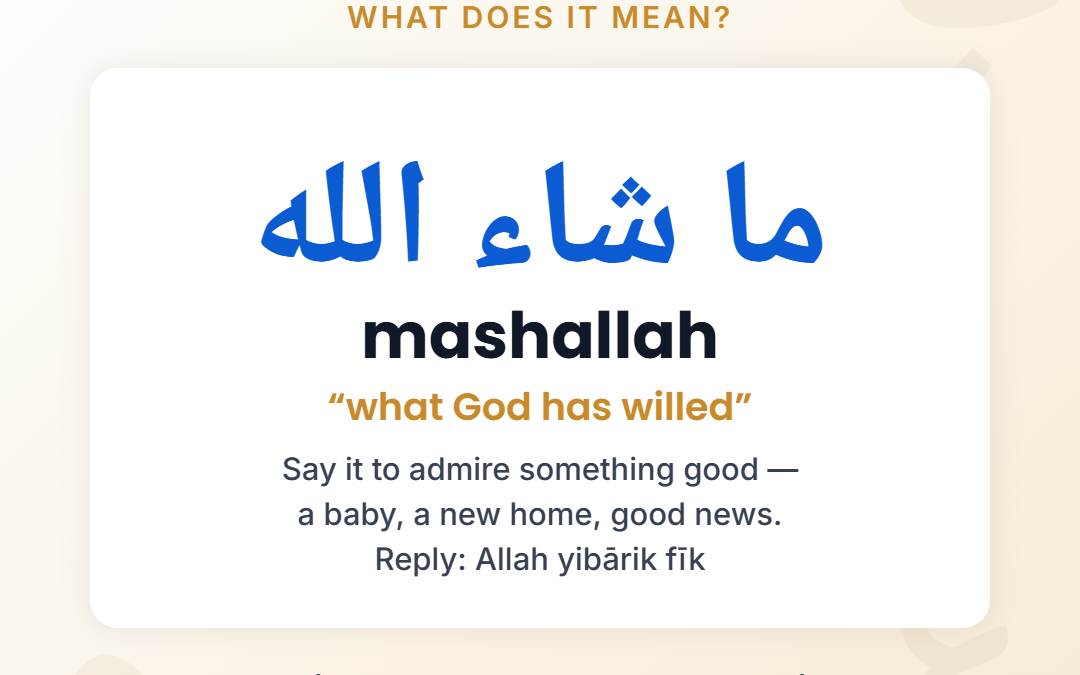
Mashallah ما شاء الله means “what God has willed.” Arabic speakers say it when they see or hear about something good — a healthy baby, a new house, a child’s exam result — to show admiration and, at the same time, to say that the good thing came from God and to wish it protection.
If inshallah looks forward (“if God wills”), mashallah looks at what is already here. It is one of the first words you will hear in any Arabic-speaking home, and one of the easiest to start using yourself.
What “mashallah” means, word by word
| Arabic | Transliteration | Meaning |
|---|---|---|
| ما | mā | what |
| شاء | shā’a | (He) willed |
| الله | Allāh | God |
Put together: mā shā’a Allāh, said quickly as ma-sha-LLAH. You will see it spelled mashallah, masha’Allah, ma sha Allah or MashaAllah in English — all the same phrase.
When people say it
- Admiring a baby or a child: “Mashallah, what a beautiful girl!” This is the classic use.
- Good news: a new job, a wedding, a recovery, a graduation.
- Something impressive: a beautiful home, a delicious meal, a strong performance.
- Compliments in general: many people add mashallah to any compliment, the way English speakers might add “honestly” — it makes the praise warm and sincere.
Why it is about more than politeness
In many Arab and Muslim cultures, praising something without mentioning God can feel careless, as if you were inviting envy (often called the evil eye, العين al-‘ayn). Saying mashallah turns the compliment into a blessing: “this is beautiful, and it is God’s gift.” That is why grandparents say it over babies, and why you will see ما شاء الله written on shop walls, car windows and wedding cards.
You do not need to be Muslim to say it. Arab Christians use it too, and non-Arabs who say it kindly are almost always met with a smile.
Mashallah vs inshallah vs alhamdulillah
| Phrase | Meaning | Looks at |
|---|---|---|
| إن شاء الله inshallah | if God wills | the future — plans and hopes |
| ما شاء الله mashallah | what God has willed | the present — something good you see |
| الحمد لله alhamdulillah | praise be to God | the past — gratitude for what happened |
A simple way to remember it: you plan with inshallah, admire with mashallah, and thank with alhamdulillah. (We explain the other two in Inshallah vs Alhamdulillah.)
How to reply when someone says “mashallah” to you
If someone admires your child, your work or your home with mashallah, the usual reply is a blessing back:
- الله يبارك فيك Allah yibārik fīk — “May God bless you” (to a man; fīki to a woman).
- بارك الله فيك bārak Allāhu fīk — the more formal version of the same blessing.
- Or simply shukran شكراً, “thank you.”
A short real-life dialogue
Layla: هذه ابنتي، عمرها سنة. Hādhihi ibnatī, ‘umruhā sana. — This is my daughter, she’s one year old.
Sam: ما شاء الله! جميلة جداً. Mashallah! Jamīla jiddan. — Mashallah! She’s very beautiful.
Layla: الله يبارك فيك. Allah yibārik fīk. — May God bless you.
Related phrases you will hear
- تبارك الله tabārak Allāh — “blessed is God,” used the same way, very common in Morocco and the Gulf.
- الله أكبر Allāhu akbar — “God is greatest,” also said in amazement at something remarkable.
- يا سلام yā salām — “wow,” a non-religious way to admire something.
Read it yourself
Try reading the phrase letter by letter: مَا شَاءَ اللّٰه. م m + long a · ش sh + long a · ء the little glottal stop (hamza) · then الله Allah. Every letter in it is taught in the first lessons of the alphabet.
Want to read words like this one on your own? Our Arabic Alphabet & Essential Vowels course is free, in English, French and German, with an Arabic keyboard on screen so you never need to install one.
FAQ
What does mashallah mean in English?
It means “what God has willed.” In practice it works like “how wonderful” or “God bless,” said when you admire something good.
Can non-Muslims say mashallah?
Yes. Arab Christians use it too, and Arabic speakers generally welcome it from learners and friends when it is said sincerely.
What is the difference between mashallah and inshallah?
Inshallah (“if God wills”) is about the future. Mashallah (“what God has willed”) is about something good that already exists.
How do you reply to mashallah?
Say “Allah yibārik fīk” (may God bless you) or simply “shukran” (thank you).
How is mashallah written in Arabic?
ما شاء الله — three words: mā (what), shā’a (willed), Allāh (God).